

I’ve often wondered, when watching this sport, what, exactly, makes for a tragic hero. It’s a term we throw around often, perhaps willy-nilly, even, without giving it much thought. When Jonas Vingegaard, for all intents and purposes, lost the Tour de France to Tadej Pogačar in the Pyrenees, when we watched him wind his way helplessly up towards the line, this was deemed tragic when in fact it was inevitable. It represented a cruel reality in which one man was simply stronger than the other.
These setbacks were treated quietly by Vingegaard, in part because he still believed, whether lucidly or not, in a final opportunity to limit his losses. In the final week of the race, it became clear he’d been saving himself for the Alps, where he pressed himself close to his rival but failed to distance him. These grim moments on Mont Ventoux and the Col de la Loze must have hurt more than those endured in the sweltering heat because they were the last moments wherein Vingegaard’s lot could change for the better. Pogačar may be an extraordinary rider, but Vingegaard’s loss to him is a rather ordinary one.
Let’s look at another example. Whenever a rider is out in a breakaway all day and is caught at the line by a barreling cavalcade of sprinters, like in the case of Mathieu van der Poel in stage 9 of this Tour, we often consider this tragic, too. Van der Poel’s heroism is that he was bold enough to spend untold kilometers first with another rider, his teammate Jonas Rickaert, and eventually on his own; that he pitted himself not only against the elements and the looming peloton but also against himself and his own resolve. His tragedy is simply that he failed to uphold this extraordinary condition until the end. However, this in itself is a small tragedy, one of the quotidian ways in which bike racing ignores what we writers would prefer to write about, with disappointing results.
If we’re to talk about tragedy – real tragedy in its purest form - this, I think, requires an era. The amount of time involved in shaping a tragedy must be long and hard-earned. It must span landscapes and years and different groups of people and how successful all those other people were in this insular little world. Time has passed quickly since I became deeply involved in professional cycling half a decade ago, and yet, it’s taken half a decade or so to see how they’re all playing out, these storylines that once arrested me and you and countless others in the first place. Getting older is a tragedy in itself, if you ask me.
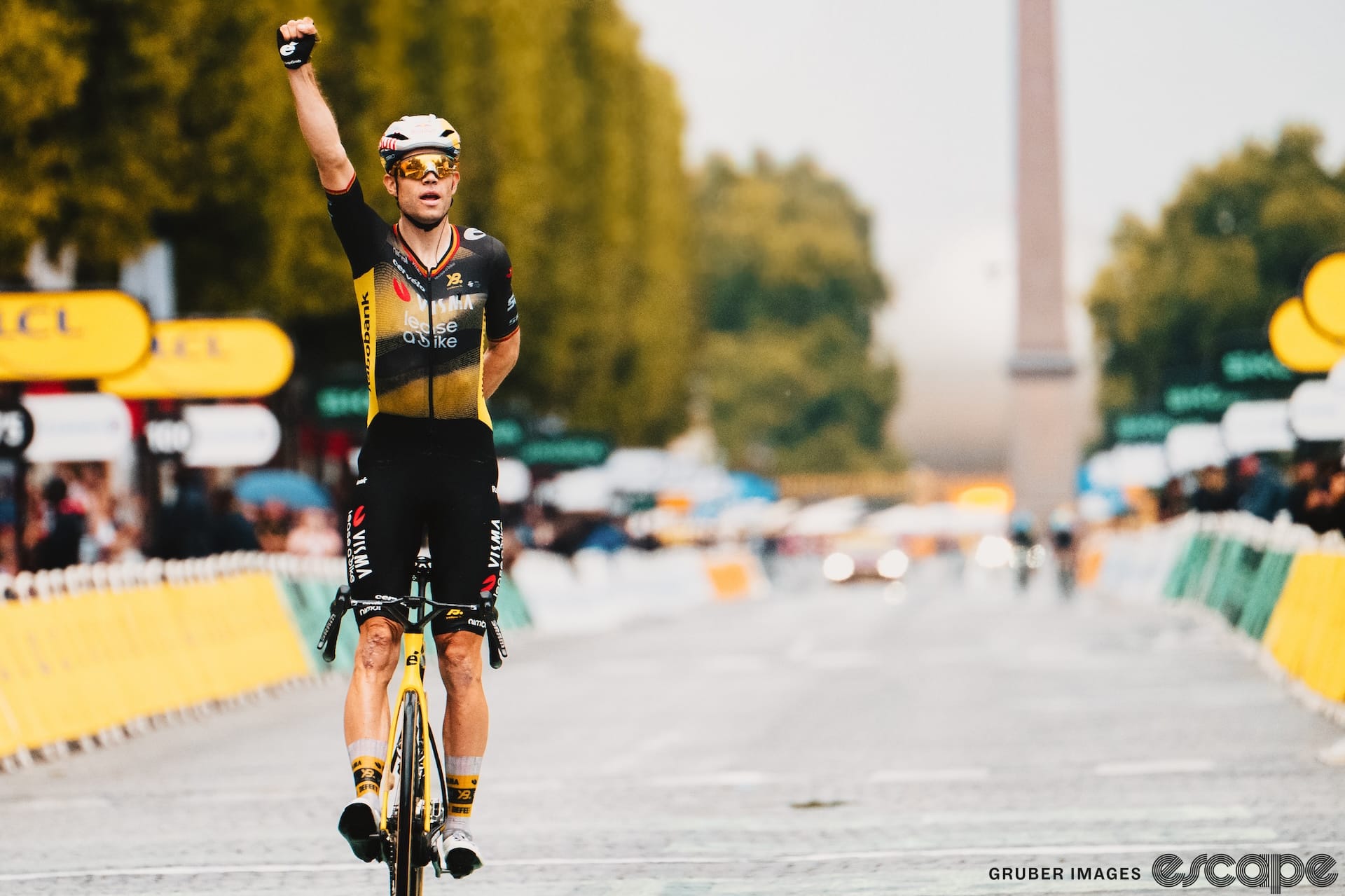
When I look back (nostalgically, I’ll admit) at these last few years, two figures emerge above all others as the prime contenders in the “Tragic Hero” classification. These are (of course) Primož Roglič and his former Jumbo-Visma teammate, Wout van Aert. I mention them here together, after giving them quite a bit of thought over the last few hours, because each met a very different end in this Tour. One vanished into the ether and the other managed to burst forth into victory, claiming the last stage in Paris for his own, on his own. Both of these ends, however, were cathartic. They resolved along different harmonic lines, perhaps, but they resolved nonetheless. Neither absolves their subject of tragedy; the stories merely end differently.
I. A Hölderlinian downfall
I mentioned the German poet Friedrich Hölderlin in my last essay, and I’m going to mention him again here, because he spent quite a great deal of effort defining the concept of tragedy in poetry, and cycling, as any fan knows, is not much different than poetry. Hölderlin believed(1) that the tragic hero was a victim of his time, a man whose tragedy mirrored as well as illuminated the simultaneous dissolution of his era. Each tragic hero contains within him existential conflicts or “extremes,” which could go any which way, but because of their very containment within the same person, often destroy him.
Did we do a good job with this story?