

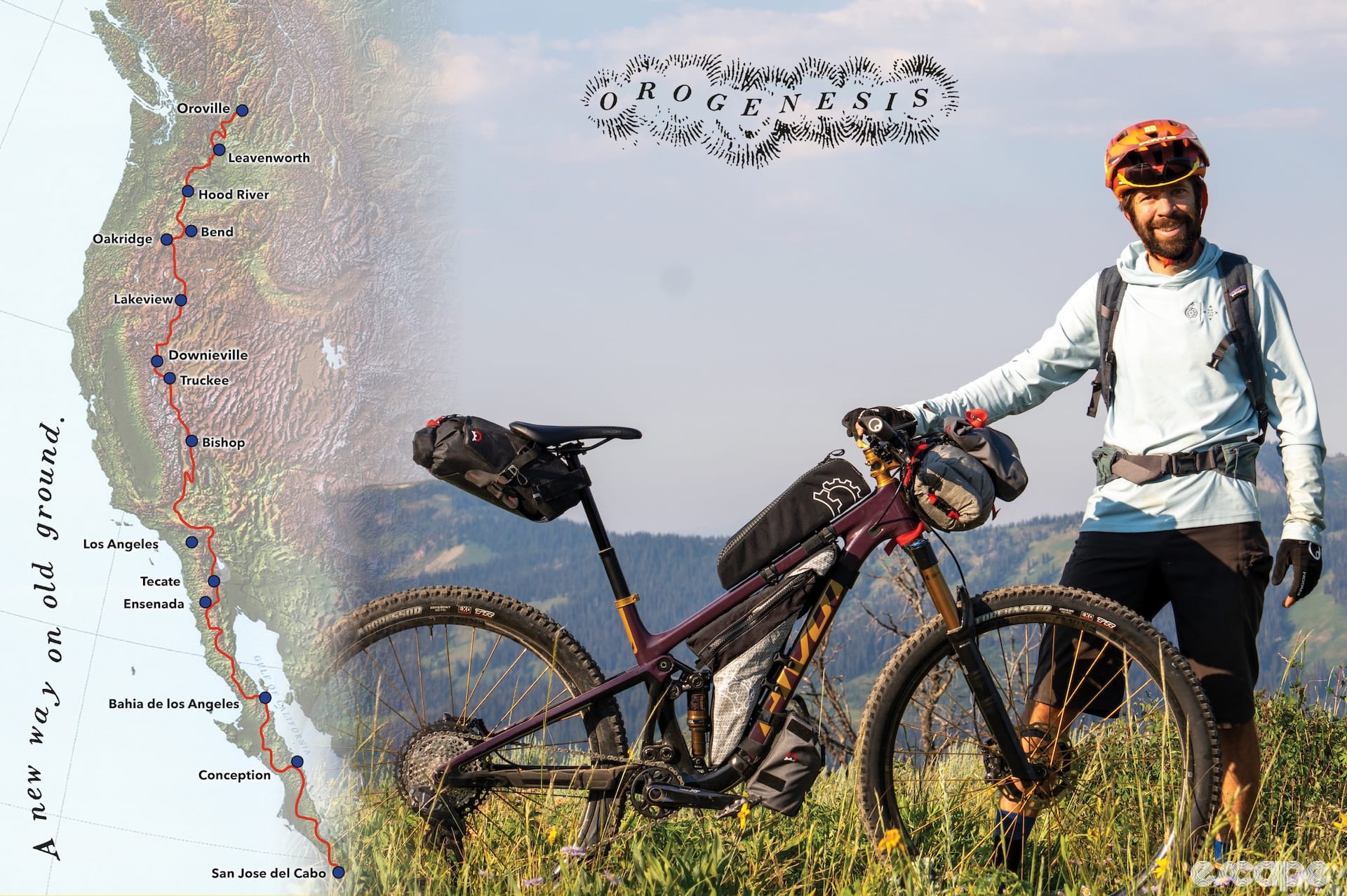

For weeks, I’ve spent my spare time staring at maps trying to determine just how intimidated I should be by an as-of-yet unridden mountain bike route. It's huge. All I have to work off for most of the first 3,500 miles is a series of squiggly lines, GPS tracks that stretch from Canada to the tip of Mexico's Baja California, through the Cascades, the Sierra Nevada, high deserts, and deep canyons. “Welcome to Orogenesis,” I say to myself nervously as my eyes trace the impressively sawtooth-like elevation profile.
Hikers seeking a long backcountry journey have the Pacific Crest Trail down the West Coast of the United States, a trail entirely off limits to cyclists, and soon, mountain bikers will have their own – Orogenesis. This new route stretches through Washington, Oregon, California, and then it connects to the existing Baja Divide bikepacking route to add another 1,600 miles to San Jose del Cabo at the southern tip of the Baja Peninsula.
The creation of such a trail is an absolutely monumental vision, and guinea pigging my way down the full length of it is all that’s on my calendar for the remainder of the year. The allure of such a vision has also been driving an unbelievably dedicated crew of mountain bikers to piece together this monster of a route in just a handful of years.
“Orogenesis” is the geologic process of mountain building – a gradual evolution powered by unfathomable forces that expand across and transform broad swaths of the landscape. In what feels like a prior lifetime, I was a geology professor and taught my wide-eyed students all about such powerful processes and the scale and grandeur of the resulting landforms. Never had it crossed my mind that I might someday strike out on a namesake trail of similar proportions.
A Collective Labor
Gabriel Tiller is the visionary behind Orogenesis. He’s a lover of old maps, faint dashed lines, knobby tires, and the smell of chainsaw exhaust and freshly cut deadfall. At times, he seems more drawn to the gaps between existing trails than to the trails themselves. He speaks about such gaps and how they might be closed through a giddy grin, and one can’t resist wanting to help him make it happen.
“I see old trails as layers of history on a landscape, or social layers,” Tiller explains. “Our mantra is 'A new way on old ground,' which is funny because nearly every time there's a missing connection and I start scouting to see if a new trail is feasible, I find that there's already a trail there. Whether it's an abandoned Forest Service trail or an elk trail, creatures have been moving across the landscape for millions of years, choosing the path of least resistance. Re-discovering these ancient ways asks the question, 'Why was this here?' and helps me connect with the land and its stories.”
Did we do a good job with this story?