


Prologue
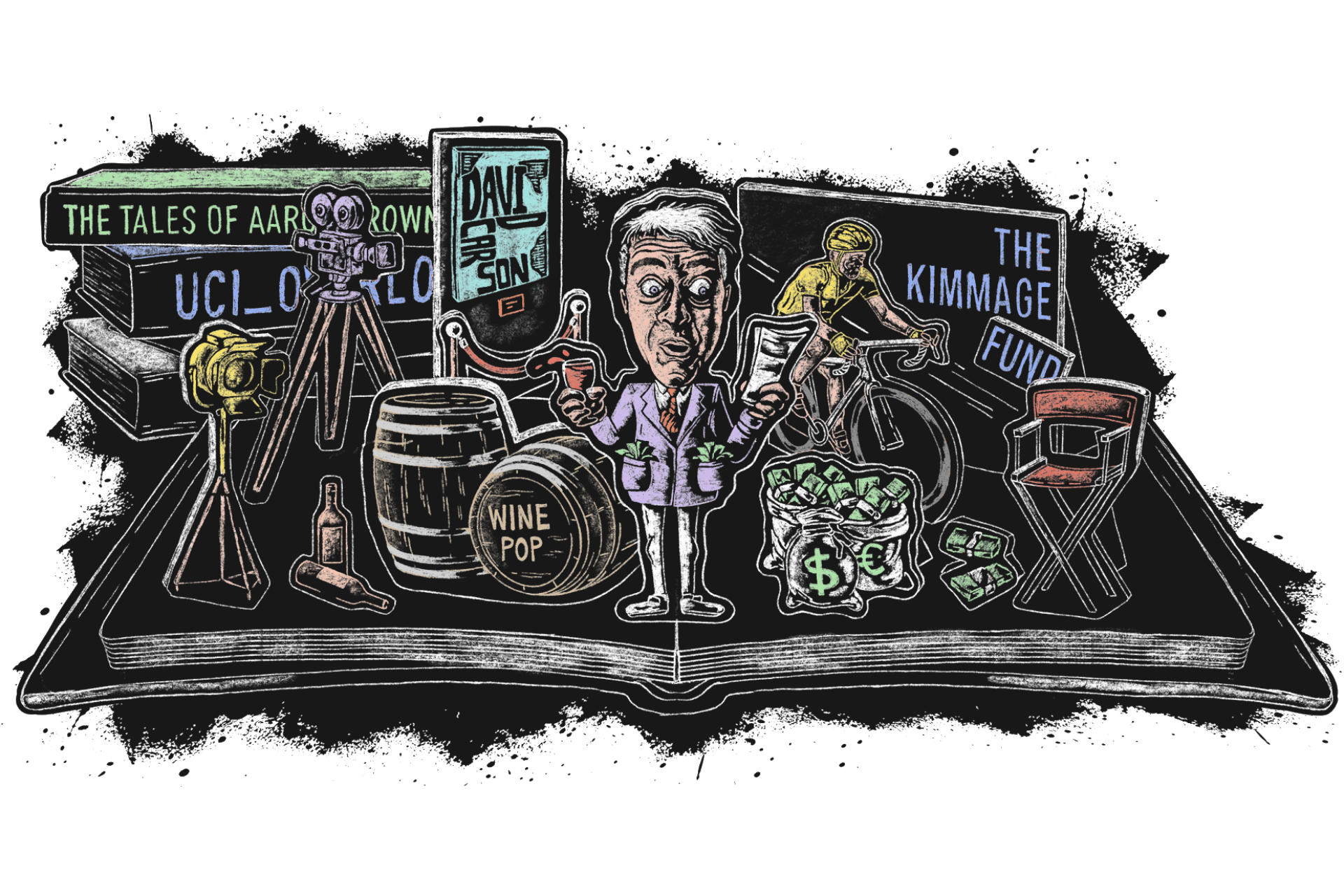
Few stories have captivated the cycling fraternity quite like the saga of the Paul Kimmage Defence Fund. In early 2013, roughly US$70,000 of the community’s money, all of it donated to a charitable cause, disappeared and was never seen again. It wasn’t just the money that vanished – so too did the enigmatic figure who controlled it: a Canadian national named Aaron Brown, a man of many guises best known as the Twitter personality @UCI_Overlord.
The story had it all. A respected journalist steadfastly pursuing the truth, a governing body flexing its muscle in questionable ways, an outraged community, and, tangled up in it all, a mysterious, shapeshifting antagonist who fled his homeland in pursuit of both opportunity and personal reinvention.
A decade on, the story of the Kimmage Fund’s disappearance remains unresolved. Is it as simple as saying that Brown took the money? If so, what did he do with it? How has he managed to avoid accountability? And what has he been up to in the years since the Kimmage Fund disaster?
In short, Brown has been busy. He’s worked in a range of different fields and changed his name multiple times, but amid all that flux, one thing has remained constant: everywhere Brown has gone, he’s left a trail of pain and anger in his wake.
This is a story that begins in the world of professional cycling in the early 2010s before branching out across industries, continents, and decades. It’s a tale that winds its way down the sleepy streets of small-town Canada, through the hilly vineyards of north-eastern Spain, into the halls of a gritty countercultural art gallery in Barcelona, and through a courtroom in Massachusetts, USA, before ultimately landing in the cut-throat world of film and television.
It’s a long and twisting tale of multiple identities and colliding worlds, of transatlantic drama and mystery. More than all that, it’s a human story of deception, anger, humiliation, and loss. At the heart of it all: Aaron Timothy Brown.
Would you prefer to listen to this story rather than read it? Click play below to hear this story in audio form, as read by the author.

Chapter 1: The Kimmage Fund
This story could begin at any one of several different points. It could begin with Brown’s childhood, growing up in an artsy household in Canada and the US in the 1970s and ‘80s. It could begin in the present day, with his recent movements in north-east Spain. But for our purposes, the story really begins in 2012 with the saga that earned Brown eternal notoriety in the cycling world: his disastrous handling of the Paul Kimmage Defence Fund.
For us, it is this saga – perhaps Brown’s biggest indiscretion in a life of many – that frames everything that’s happened since.
In January 2012, cycling’s governing body, the Union Cycliste Internationale (UCI), filed a defamation lawsuit against Irish former pro racer turned journalist Paul Kimmage. The UCI’s then-president, Pat McQuaid, and former president, Hein Verbruggen, had taken offence at comments Kimmage made in the media, not least the suggestion the UCI had overlooked a positive doping test by Lance Armstrong at the 2001 Tour de Suisse.
When Kimmage received a subpoena later that year, compelling him to attend a Swiss district court in December 2012, he found himself in a bind. He’d recently been laid off by the UK’s Sunday Times, leaving him unable to pay the legal fees that were headed his way. Outraged by the UCI’s aggressive pursuit of Kimmage, some members of the cycling fraternity took it upon themselves to set up a crowdfunding campaign to cover the Irishman’s legal fees.
One of the people behind that fund: Aaron Brown.
Brown came to the sport as a fan of pro racing and as an amateur rider from back in the day. But in the early 2010s – then in his late 30s – Brown managed to establish himself as an authority on the inner workings of the sport, courtesy of his @UCI_Overlord Twitter account.
In the words of journalist Joe Lindsey, who wrote a seminal article about the Kimmage Fund drama for Bicycling back in 2013:
“The [@UCI_Overlord] account was funny and knowing, skewering UCI president Pat McQuaid and his attitude and approach to running the sport. Despite being an outsider to pro cycling, [Brown] managed to come across as knowledgeable about the sport and its players and inner workings, often accompanied by a mock-sinister mirthfulness that became his signature phrase: *chuckle*.”

To many who witnessed it, Brown’s rise to prominence was confusing: he seemed more connected than those who’d spent decades in the sport, and even had direct lines of communication into the halls of the UCI. Brown claimed to know and called many pro riders friends but much of the racing community viewed him with scepticism.
Brown was a prolific tweeter and soon ventured out into other areas of the cycling media sphere. He appeared on the Flammecast podcast, the beginnings of his collaboration with Massachusetts-based journalist, editor, and producer, Lesli Cohen. When Flammecast stopped (it’s since been revived), Brown and Cohen decided to collaborate more formally.
The pair created Cyclismas, a cycling satire website that prided itself on providing “an alternative to traditional cycling news coverage”. After launching in time for the 2011 Tour de France, Cyclismas built a small but loyal following.
There wasn’t a formal business arrangement in place between Brown and Cohen but Cohen took on the role of Cyclismas’s editor-in-chief while Brown handled the business side of things and was also the site’s headline contributor, writing under his UCI Overlord persona. It wasn’t a full-time role for either of them – Cohen was busy “editing and doing some writing for different local publications”, and Brown was busy helping out his then-partner Maria Gallardo at the café they ran together in Bridgewater, Nova Scotia, Canada.
UCI Overlord wasn’t the only character Brown played at Cyclismas. He also wrote for the site as “reporter” Frank Mercer, and worked in ad sales as “site publisher”, Bill Thacker. Most visibly, though, Brown appeared as Ripp Finklemann, bombastic host of the Cyclismas Cycling News Network (CCNN) TV series. His offsider: Jonny Gunn, played by Cyclismas video producer Justin Pickens.
When Paul Kimmage was subpoenaed by the UCI in September 2012, Cyclismas was front and centre as the idea of a support fund grew.
Cohen was in talks with Andy Shen of NYVelocity.com as well as the individual behind the acerbic and anonymous Twitter account, Digger Forum, to create a crowdfunding campaign. But with the others reluctant or unable to set up the website widget that would accept donations, the task fell to Cohen.
Donations to the Kimmage Fund were directed through to the Cyclismas PayPal account – the same one that had been created to handle the site’s merchandise sales. The choice to use this PayPal account was seemingly insignificant at the time, but it would ultimately prove pivotal to the whole saga.
Once established in late September 2012, the Kimmage Fund took off. News of the fund quickly spread to all major road cycling news outlets, and then it hit the mainstream press, too. The response was emphatic. Many cycling fans, those in the media, and even pro riders were supportive of Kimmage and outraged that the UCI would target a journalist so pointedly (while, notably, not suing the media outlets involved.)
The fund raised US$23,000 in the first week. And when donations closed on December 31, 2012, around 3,600 people had pitched in, netting a total of US$93,099.
Crucially, all of that money was in the Cyclismas PayPal account, under the sole control of Aaron Brown.

In December 2012, with donations to the Kimmage Defence Fund winding to a close, Brown transferred US$23,164 from the Cyclismas PayPal account to Kimmage to pay for the legal fees the journalist had accrued to that point. With that transfer made, US$69,935 worth of donations remained. But things were about to get messy.
By the time Brown had sent money to Kimmage, the UCI had already suspended its legal action against the Irishman. As it turned out, the governing body had a bigger problem on its hands.
A couple months earlier, the US Anti-Doping Agency (USADA) had handed Lance Armstrong a lifetime ban for doping throughout his career. In a 202-page document explaining the ban, USADA came down hard on the UCI, accusing the governing body of a long-held laissez-faire attitude toward doping.
In response, the UCI launched a “fully independent external commission” into doping and its own handling of the issue. It was at that time that the UCI suspended its legal action against Kimmage, “pending the findings” from the commission. McQuaid and Verbruggen, both individual parties to the case, followed suit.
As 2012 rolled into 2013, Brown and his then-partner Gallardo sold their café in Bridgewater and moved with their son – then on the cusp of starting school – to Girona, Spain. Brown had a plan to take Cyclismas to the next level; to visit races and riders in person, rather than covering the sport remotely. Moving to one of professional cycling’s hotbeds seemed like a good option.
Brown (left) and Pickens in a November 2012 clip from CCNN-TV. (Image: Cyclismas)
Brown had convinced Pickens to join him on his European adventure and so in January 2013, Pickens and his family packed up and flew over from Canada to Spain as well. Pickens hadn’t signed a contract – he’d just made a verbal agreement with Brown that he’d be paid on the 15th of every month.
According to Pickens, it didn’t take long for his promised salary payments to stop. His January pay came through in full and on time, but in February it came in late (and, strangely, via PayPal). His March pay was late again, and less than he was owed. That was the last payment he received.
By April, Cohen was starting to suspect Brown had been paying Cyclismas wages from the Kimmage Fund. She says Brown admitted as much to her. Indeed, in an audio recording from late April 2013, Brown tells Pickens the latter had been paid from the charitable fund. “Technically there was funds that I dispersed for you, to you from the Kimmage Fund directly,” Brown says, “which I reimbursed from my personal funds.”
When Cohen got access to the Cyclismas PayPal account for the first time, it showed a balance of $0, with a series of transfers between late December 2012 and early March 2013 to Siroque Holdings – a company in Brown’s control.
When Cohen and Kimmage both demanded an accounting of the Kimmage Fund, Brown declined. On April 30, 2013, Cohen filed a lawsuit to dissolve the Cyclismas business partnership. Further legal action would follow.
Brown countersued Cohen for allegedly defaming his UCI Overlord personality (among other allegations), claiming US$2 million in damages. And then in September 2013 a Wisconsin judge, Bill Hue – himself a donor to the Kimmage Fund – initiated a class action against Brown, on behalf of all donors.
It was around this time that newly elected UCI president Brian Cookson reached out to Kimmage to confirm the UCI’s legal action against the journalist would be dropped for good. It seemed the money in the Kimmage Fund would no longer be required.
With public pressure mounting, Brown tried to deal with the money he’d moved out of the Cyclismas account, launching the Kimmage Fund Refund website to handle refunds.

In a post on his refund site, Brown declared there was US$64,821.75 remaining of the Kimmage Fund and that donors who wanted a refund would get 70% of their donation back – only 30% of the fund had been used. Brown also vowed to donate any unclaimed money to a charity of Kimmage’s choosing.
It’s hard to say exactly how many refunds Brown issued in the months that followed. Co-founder of Escape Collective, Wade Wallace, received a refund for the contribution he made, and Brown also tried to refund Bill Hue’s donation (which Hue promptly rejected).

Regardless of how many donors received refunds – Cohen thinks almost nobody did – it was throughout this process that we were starting to see the final tendrils of Brown’s association with the cycling world. He’d long stopped posting as @UCI_Overlord on Twitter (his last post was on May 8, 2013, answering questions about the state of the fund) and his last article on the Kimmage Fund Refund site was on December 31, 2013, saying donors would have until June 1, 2014 to claim their money back.
The case of the Kimmage Fund would rumble on in the Massachusetts court system for several years to come. By that point, though, Brown had long left the sport behind – he’d been building an entirely different life for himself, well away from cycling.
Like what you're reading? There's more after the jump, but you'll have to be a member to read it. Escape Collective is 100% membership-funded, with no advertising and no affiliate links in our product reviews. Our work is only possible through your support. Need another reason to join? Our Member Purchase program offers discounts of 20% or more from participating brands like Velocio, Ritchey, Hunt Wheels and more (we get no revenue from your purchases; this is purely a member benefit).
Did we do a good job with this story?


