

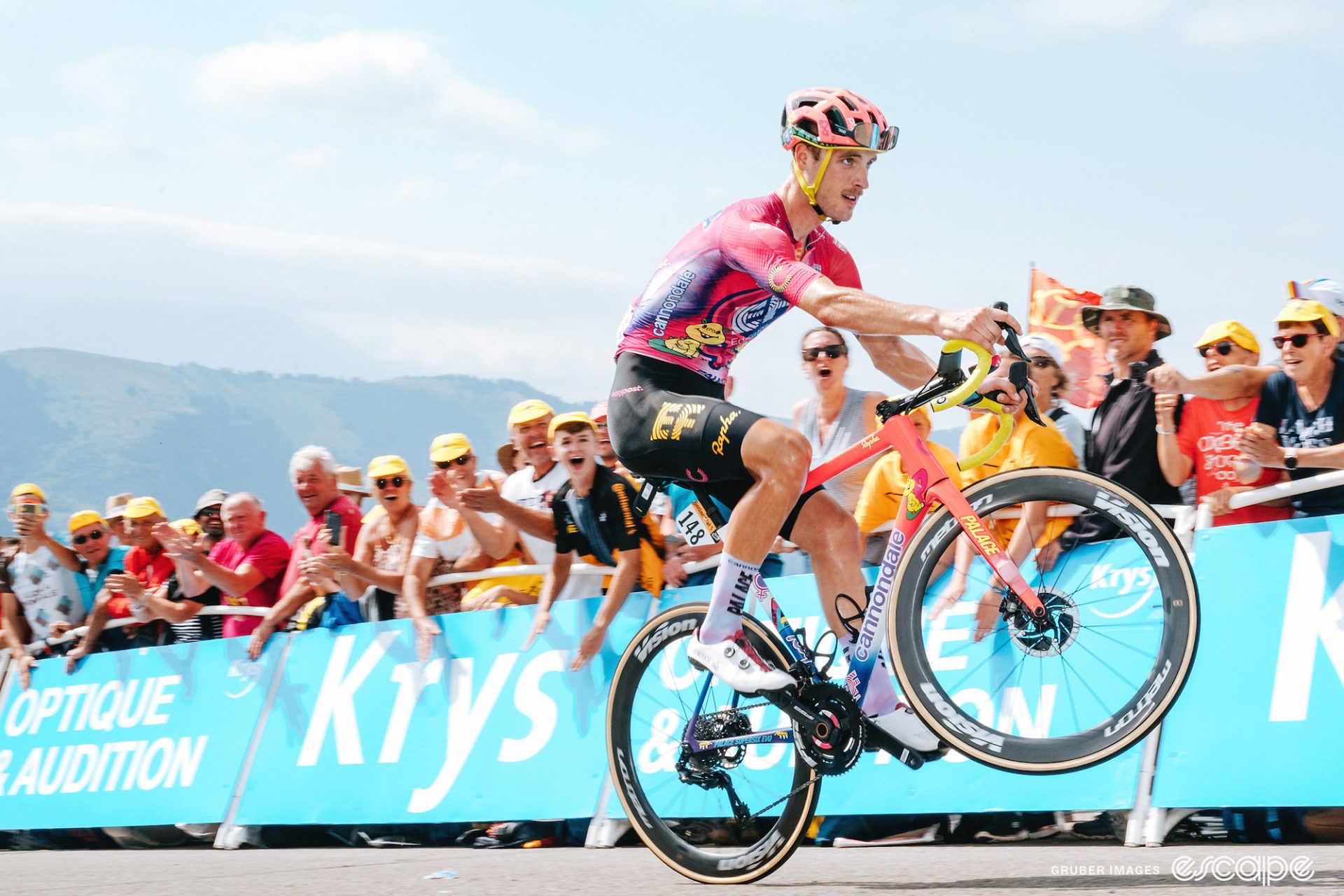

The Tour de France is complicated. Three weeks long, full of flat stages, mountain stages, and individual time trials. It has 21 winners but also one winner, and then other winners of other categories too? And a team wins? But also nobody really cares which team wins. Polka dots are involved somehow? And what on earth is a horse category?
We did the math recently and our staff has covered more than 50 Tours de France between them. So we feel we have the expertise to answer those questions and many more.
If you have friends with questions, feel free to send them this. There's no paywall on this story. We're going to start basic and then go real deep.
For quicker perusing, here are the topics covered:
- When is the 2025 Tour de France?
- How long is it?
- How does the Tour de France work?
- What about the green jersey and the polka dot jersey?
- Is cycling a team sport?
- So what is drafting?
- Are substitutions allowed?
- What's a domestique?
- Do cycling teams have positions like ball sports?
- What's a breakaway and why do they exist?
- A rider is ahead of everyone, but are apparently not winning. What gives?
- What's the deal with time trials?
When is the 2025 Tour de France?
The Tour de France starts in Lille on July 5 this year and ends on the 27th in Paris.
How long is it?
The Tour is three weeks long. Twenty-one stages, with two rest days in the middle with no racing. The exact length varies year by year, and in 2025 riders will race 3,338.8 km (2,074.6 miles).
How does the Tour de France work?
The simplest version: Each stage, one per day, is its own race. The whole Tour de France is a championship of sorts, totalling up those daily races. The yellow jersey is the champion, and the winner of it is decided by the fastest total time across all the stages combined, not points.
To win the Tour de France, a rider must complete the 21 days of racing in the least amount of time. Each rider's total time for each day, or stage, is added up as the race goes on, and whoever has the lowest rolling total after a given stage wears the yellow jersey (maillot jaune, in French), the next day. This rolling total is called the General Classification, or GC.
If you have the lowest cumulative time at the end of the final stage, and thus are the best-placed rider on the General Classification, you win the Tour de France. You receive a big stuffed lion, some champagne, and get to stand on a podium on the Champs-Élysées as the sun sets behind the Arc de Triomphe and give a speech thanking your teammates and family. Well done!
There are other things you can win along the way. Each stage has a winner, too. Winning a stage is a huge deal, particularly for those riders who don't have the right body type or just aren't quite good enough (sad) to fight for the yellow jersey.
There are 23 teams in the Tour de France. Each team has eight riders. These riders have various jobs, like a ball sport. Some are there to support a leader, some are there to be the leader, some are there to sprint or to climb. More on this below.
What about the green jersey and the polka dot jersey?
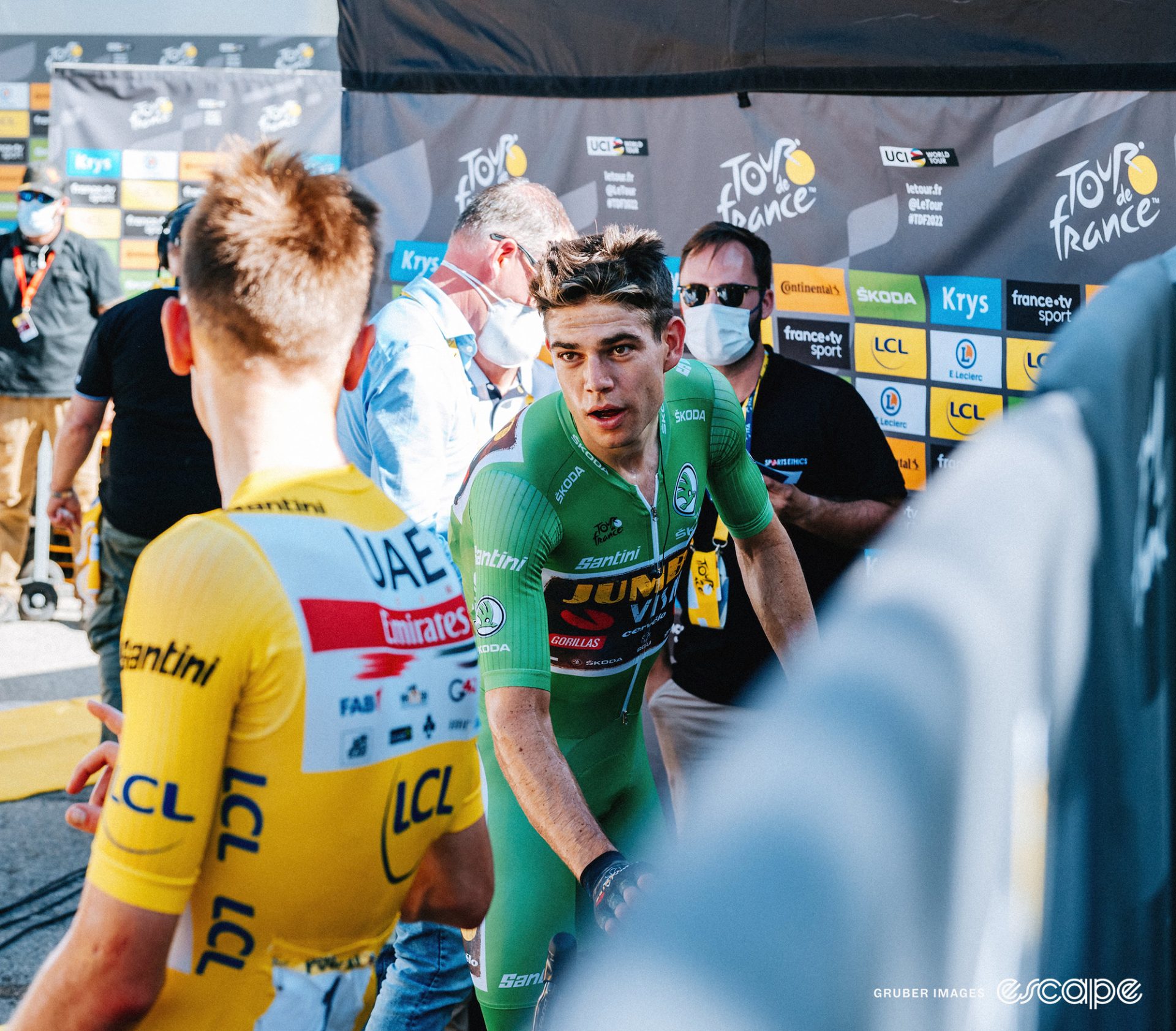
Most other riders are in the jerseys of their teams, or sometimes a special jersey for being a national champion of their country. There are three exceptions, in addition to the yellow jersey of the race leader.
The green jersey (maillot vert) is the points jersey. The green jersey is won by whoever has the most points at the end of the race, and during the race it's worn by whoever has the most cumulative points so far.
Points are awarded at finish lines, particularly flat finish lines, as well as at little fake finish lines in the middle of each stage, called intermediate sprints. Riders sprint for these finish lines, real or fake, and accumulate points. There are more points available on flat stages – which favor sprinters – than there are on mountain stages. For that reason, it is sometimes known as the sprinter's jersey, because that tends to be the type of rider who contests for it.
For mountain stages, there are a different type of points available. These are for the King of the Mountains competition, and those points accumulate to determine who wears the polka dot jersey (maillot à pois). The points for this jersey are awarded in roughly the same way as for the green jersey, except riders gain points by reaching the tops of mountains ahead of their competitors. The bigger the climb, the more points on offer, with the highest amounts for summits that also serve as finish lines for a stage. Hors Categorie is the hardest, and means beyond categorization. So hard you can't even put a number to it.
You'll see riders who are targeting this competition engage in seesaw battles over multiple stages in the mountains. One day, one rider will attack and take a big haul of points to go into the lead, and the next day someone else will do the same. Since it's hard to attack multiple days in a row, riders have to pick the days they think offer the best chance for them to score points.
Finally, we have the white jersey (maillot blanc). This is for the best young rider. It is awarded in exactly the same way as the yellow jersey, but only riders under the age of 25 qualify. Lately, that has meant the yellow jersey and white jersey are often won by the same rider because the winners of the Tour have been so unbelievably young. A rider can't wear two jerseys, of course, and the yellow jersey takes precedence. So whoever is in second place in the young rider competition gets to borrow the jersey until the finish. This is true of all special jerseys; there is an order of importance that is adhered to.
Is cycling a team sport?
Yes and no. Mostly yes.
Did we do a good job with this story?


